


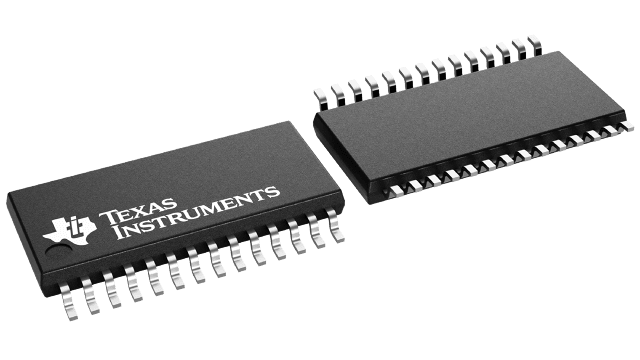


| Number of channels (#) | 16 |
| LED current per channel (mA) | 120 |
| LED configuration | Parallel, Series, Single |
| Vin (Min) (V) | 3 |
| Vin (Max) (V) | 5.5 |
| Iout (Max) (A) | 1.92 |
| Features | Analog/PWM mixed dimming, Constant current, Current control, I2C control |
| Iq (Typ) (mA) | 25 |
| Operating temperature range (C) | -40 to 85 |
| | |
| Rating | Catalog |
- 16 LED Drivers (Each Output Programmable at Off, On,
Programmable LED Brightness, or Programmable Group
Dimming and Blinking Mixed With Individual LED Brightness) - 16 Constant-Current Output Channels
- 256-Step (8-Bit) Linear Programmable Brightness Per LED
Output Varying From Fully Off (Default) to Maximum Brightness
Using a 97-kHz PWM Signal - 256-Step Group Brightness Control Allows General Dimming
[Using a 190-Hz PWM Signal From Fully Off to Maximum
Brightness (Default)] - 256-Step Group Blinking With Frequency Programmable From
24Hz to 10.73s and Duty Cycle From 0% to 99.6% - Four Hardware Address Pins Allow 14 TLC59116 Devices to
Be Connected to Same I2C Bus - Four Software-Programmable I2C Bus Addresses (One
LED Group Call Address and Three LED Sub Call Addresses)
Allow Groups of Devices to Be Addressed at Same Time in Any
Combination - Software Reset Feature (SWRST Call) Allows Device to Be Reset
Through I2C Bus - Up to 14 Possible Hardware-Adjustable Individual I2C
Bus Addresses Per Device, So That Each Device Can Be
Programmed - Open-Load and Overtemperature Detection Mode to Detect
Individual LED Errors - Output State Change Programmable on Acknowledge or Stop
Command to Update Outputs Byte-by-Byte or All at Same Time
(Default toChange on Stop) - Output Current Adjusted Through an External Resistor
- Constant Output Current Range: 5mA to 120mA
- Maximum Output Voltage: 17V
- 25-MHz Internal Oscillator Requires No External Components
- 1-MHz Fast-mode Plus (FMT) Compatible I2C Bus
Interface With 30-mA High-Drive Capability on SDA Output for
Driving High-Capacitive Buses - Internal Power-On Reset
- Noise Filter on SCL and SDA Inputs
- No Glitch on Power-Up
- Active-Low Reset
- Supports Hot Insertion
- Low Standby Current
- 3.3-V or 5-V Supply Voltage
- 5.5-V Tolerant Inputs
- Offered in 28-Pin Thin Shrink Small-Outline Package (TSSOP) (PW)
and 32-Pin Quad Flatpack No Lead (QFN) - –40 °C to 85 °C Operation
- APPLICATIONS
- Gaming
- Small Signage
- Industrial Equipment
All other trademarks are the property of their respective owners
The TLC59116 is an I2C bus controlled 16-channel LED driver that is optimized for red/green/blue/amber (RGBA) color mixing and backlight application. Each LED output has its own 8-bit resolution (256steps) fixed-frequency individual PWM controller that operates at 97kHz, with a duty cycle that is adjustable from 0% to 99.6%.
The individual PWM controller allows each LED to be set to a specific brightness value. An additional 8-bit resolution (256steps) group PWM controller has both a fixed frequency of 190Hz and an adjustable frequency between 24Hz to once every 10.73seconds, with a duty cycle that is adjustable from 0% to 99.6%. The group PWM controller dims or blinks all LEDs with the same value.
Each LED output can be off, on (no PWM control), or set at its individual PWM controller value at both individual and group PWM controller values.
The TLC59116 operates with a supply voltage range of 3 V to 5.5 V and the outputs are 17 V tolerant. LEDs can be directly connected to the TLC59116 device outputs.
Software programmable LED Group and three Sub Call I2C-bus addresses allow all or defined groups of TLC59116 devices to respond to a common I2C-bus address, allowing for example, all the same color LEDs to be turned on or off at the same time or marquee chasing effect, thus minimizing I2C-bus commands.
Four hardware address pins allow up to 14 devices on the same bus.
The Software Reset (SWRST) Call allows the master to perform a reset of the TLC59116 through the I2C-bus, identical to the Power-On Reset (POR) that initializes the registers to their default state causing the outputs to be set high (LED off). This allows an easy and quick way to reconfigure all device registers to the same condition.